Showing posts with label Anser Observatory. Show all posts

Tadpole (IC410) and Flaming Star (IC405) Nebulae

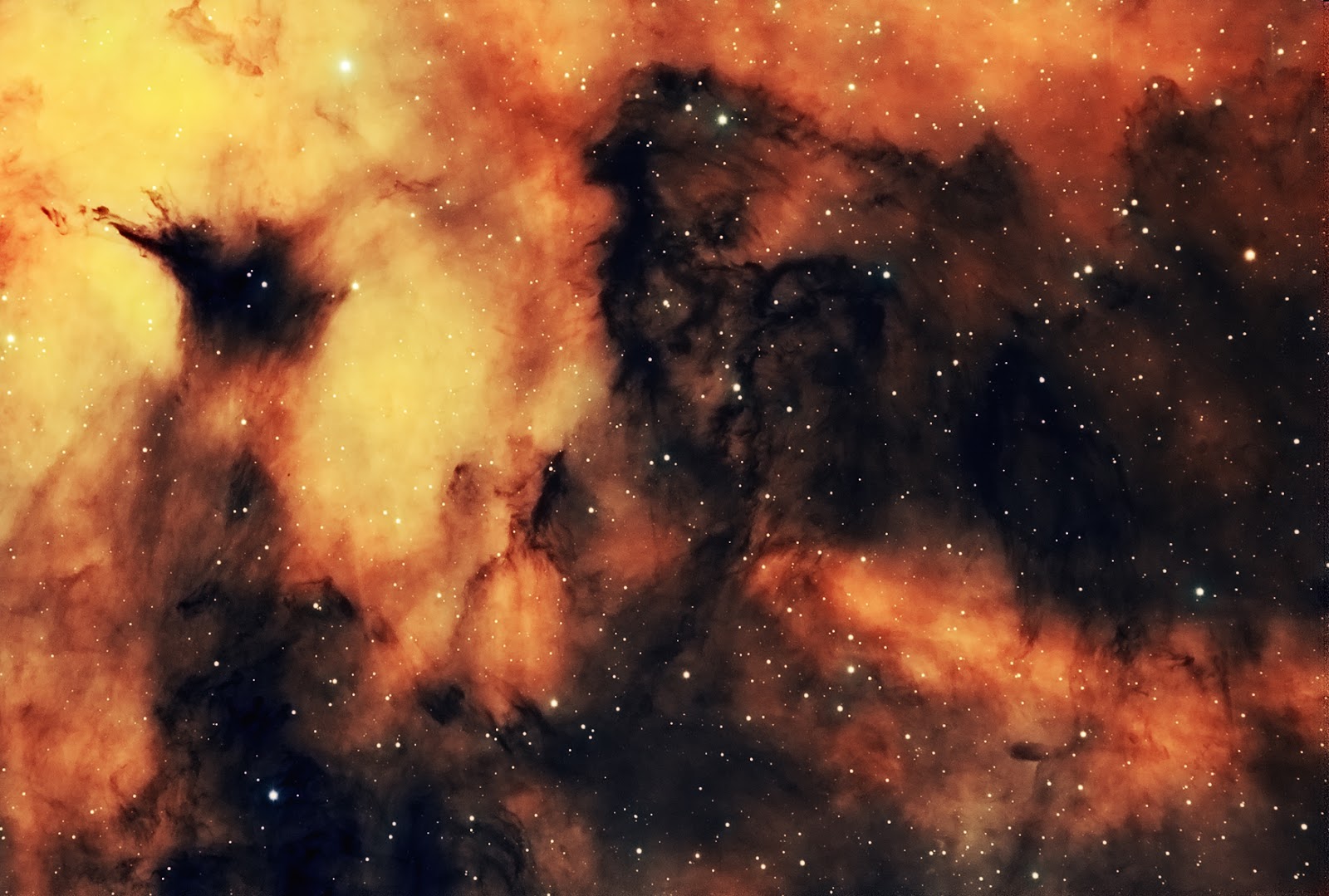
This widefield narrowband Ha-OIII bicolour composite image shows the Tadpole and Flaming Star nebulae in the constellation of Auriga. The Flaming Star nebula (bottom centre) appears as a corrugated cloud of glowing hydrogen gas that is energised by the hot O-type star AE Aurigae. The nebula lies about 1,500 light years distant and spans about 5 light years. IC 410 (top left) is significantly more distant, some 12,000 light-years away. The star forming region is famous for its embedded young star cluster, NGC 1893, and tadpole-shaped clouds of dust and gas. The radiation from these hot young stars pushes the gas away from them and creates the darker hole like features just below the star cluster.

The limited number of sub-images available to create this image has severely limited its quality and definition. I plan to revisit this area during the winter of 2017 with a new wideband dual telescope rig to capture more data that will enable a more refined image to be presented.

Right ascension: 05h 19m 23.53s | Declination: +33° 59' 11.8" | Distance: 12,000 Light Years (IC410)
Field of view: 234 x 176 arcmin

Camera: QSI 583wsg
Optics: TS Photoline TS60ED F/4.3 APO with Photoline x0.79 reducer
Guiding: Off-axis with Lodestar guider
Filters: Baader Ha (7nm), OIII (8.5nm)
Exposures: Ha 13 x 20 min, OIII 19 x 20min
Total exposure: 10.6 hours
Image composition: Ha-OIII bicolour composite
Scale: 4.2 arcsec/pixel
Image acquired: Over five nights between 7th January 2016 and 13th March 2016.

Image capture with MaxIm DL, FocusMax, ACP; Image reduction with MaxIm DL; Image processing with PixInsight and Photoshop CC 2017

Veil Nebula Supernova Remnant

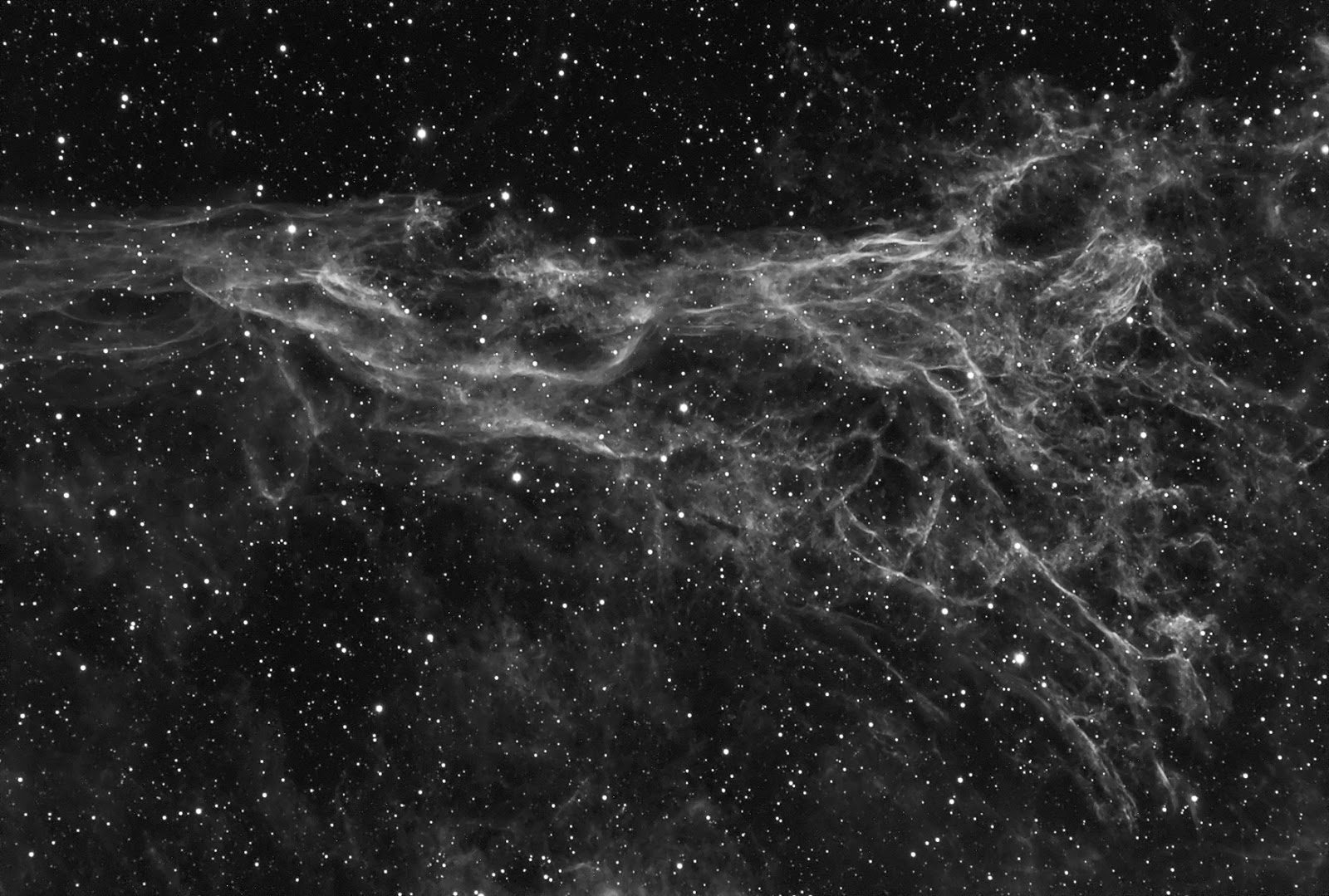
The glowing arc of the Veil Nebula spans some 110 light years of the summer sky in the constellation of Cygnus. The delicate filamentary structures are caused by an advancing shock front from a supernova as it crashes into the stationary gases of the interstellar medium.  It is estimated the supernova event took place about 8,000 years ago, and involved a star twenty times the mass of the Sun. Before the star exploded, it is hypothesised it expelled a strong stellar wind that excavated a large cavity into the surrounding interstellar gas. As the shock wave from the supernova expands outwards and encounters the walls of this cavity so it forms the nebula’s distinctive structures.

The image shows emission features of Hydrogen (red) and Oxygen (blue) as interstellar gas is swept into and excited by particle collisions at the shock front which is moving at almost 1.5 million kilometres per hour. Bright filaments are produced as the shock wave interacts with a relatively dense cavity wall, whilst fainter structures are generated by regions nearly devoid of material.

Right ascension: 20h 51m 43.06s | Declination: +30° 50' 25.5" | Distance: 1,500 Light Years
Field of view: 234 x 176 arcmin

Camera: QSI 583wsg
Optics: TS Photoline TS60ED F/4.3 APO with Photoline x0.79 reducer
Guiding: Off-axis with Lodestar guider
Filters: Baader Ha (7nm), OIII (8.5nm)
Exposures: Ha 21 x 20 min, OIII 27 x 20min
Total exposure: 16 hours
Image composition: Ha-OIII-OIII RGB colour composite
Scale: 4.2 arcsec/pixel
Image acquired: Over six nights between 1st October 2016 and 4th November 2016.

Image capture with MaxIm DL, FocusMax, ACP; Image reduction with MaxIm DL; Image processing with PixInsight (DBE) and Photoshop CC 2017

Soul Nebula Detail (IC1871)

These dark and menacing dust clouds outlined by bright crests of glowing gas are catalogued as IC 1871.  About 25 light-years across, the image spans only a small part of the much larger Soul nebulae.  At an estimated distance of 6,500 light-years the star-forming complex lies within the Perseus spiral arm of the Milky Way in the constellation Cassiopeia.  The image shows a region of triggered star formation, where the dense star-forming clouds of IC 1871, created by the shock wave of a massive star in its final death throes, are in turn being sculpted by the intense winds and radiation of a new wave of massive young stars.  The whole progression, from the death of one star to the birth of others, takes millions of years to complete.

Right ascension: 02h 56m 30.18 | Declination: +60° 40' 30.7" | Distance: 6,500 Light Years
Field of view: 42 x 28 arcmin

Camera: SBIG ST-10XME
Telescope: APM 152-1200ED F/7.9
Guiding: Starlight Xpress Active Optics SXV-LF-AO
Mount: 10Micron GM1000 HPS
Filters: Astrodon Ha (3nm), OIII (3nm)
Exposures: Ha 18 x 30 min, OIII 20 x 30 min
Total exposure: 19 hours
Scale: 1.15 arcsec/pixel
Image acquired: 2 nights in Dec 2016 and 3 nights in Jan 2017

Image capture with MaxIm DL, FocusMax, ACP; Image processed with MaxIm DL; PixInsight v1.8 Deconvolution; Photoshop CC 2015

The Pac-Man Nebula (NGC 281)

NGC 281 is a bright emission nebula in the northern constellation of Cassiopeia located in the Perseus Spiral Arm of our Milky Way. It is a diffuse HII region some 48 light years across where active star formation has created an intense radiation environment that has progressively hollowed out the centre of the nebula.  The open star cluster IC 1590 (at the centre of the image), dominated by the massive multiple-star system HD 5005, is the main source of ionising radiation within the nebula.  A variety of elephant trunk-like pillars can be seen at the lower margin of the nebula pointing like accusing fingers at the source of their demise.  These structures are made up of higher density material that erodes more slowly while the surrounding dark nebula is stripped away. As this higher density material gravitationally collapses it forms yet more stars.  Backlit by the glow of ionised gas within the nebula, several small isolated black patches of material are evident. These are known as Bok globules and contain one or more protostars that will eventually become visible once the globule dissipates.

Colloquially, NGC 281 is also known as the Pac-Man Nebula for its visual resemblance through amateur telescopes to the 1980’s arcade game character.

Right ascension: 00h 53m 02.50 | Declination: +56° 37' 03.0" | Distance: 9,200 Light Years
Field of view: 42 x 28 arcmin

Camera: SBIG ST-10XME
Telescope: APM 152-1200ED F/7.9
Guiding: Starlight Xpress Active Optics SXV-LF-AO
Mount: 10Micron GM1000 HPS
Filters: Astrodon Ha (3nm), OIII (3nm)
Exposures: Ha 19 x 20 min, OIII 19 x 20 min
Total exposure: 12.7 hours
Scale: 1.15 arcsec/pixel
Image acquired: 5 nights in October and November 2016

Image capture with MaxIm DL, FocusMax, ACP; Image processed with MaxIm DL; PixInsight v1.8 Deconvolution; Photoshop CC 2015

Seyfert galaxy M106

Messier 106 (also known as NGC 4258) is an intermediate spiral galaxy in the constellation Canes Venatici located about 22 to 25 million light-years away from Earth.  It is a classic example of a type II Seyfert galaxy with a bright compact core and tightly wound spiral arms.  In visible light Seyfert galaxies look very much like normal spiral galaxies but are highly energetic when observed at ultraviolet and infrared wavelengths.  They are intensely studied because they are thought to be powered in the same way as the more luminous and faraway quasars.

Right ascension: 12h 18m 57.4s | Declination: +47° 18' 25.6" | Distance: 22-25 Million Light Years
Field of view: 42 x 28 arcmin

Camera: SBIG ST-10XME
Telescope: APM 152-1200ED F/7.9
Guiding: Starlight Xpress Active Optics SXV-LF-AO
Mount: 10Micron GM1000 HPS
Filters: Astrodon Generation 2 Tru-Balance LRGB filters
Exposures: L 38 x 10 min, R 20 x 10 min, G 16 x 10 min, B 12 x 10 min
Total exposure: 14.3 hours
Scale: 1.15 arcsec/pixel
Image acquired: 7 nights in March / April / May over the years 2015-2017

Image capture with MaxIm DL, FocusMax, ACP; Image processed with MaxIm DL; PixInsight v1.8; Photoshop CC 2015

The Jellyfish Nebula (IC443)


The Jellyfish Nebula is an expanding bubble-shaped cloud of debris from a massive star that exploded over 30,000 years ago.  The nebula is about 5,000 light-years distant in the constellation Gemini.  It is a faint and elusive object but is captured here using the technique of emission line imaging using Hydrogen Alpha (Ha) and Oxygen III narrowband filters.  The image is a Ha-OIII-OIII false colour composite with an added luminance layer created from the first component of a Principal Component Analysis (PCA) of the multiband image.

Right ascension: 06h 17m 31.71s | Declination: +22° 39' 45.3" | Distance: 5,000 Light Years
Field of view: 42 x 28 arcmin

Camera: SBIG ST-10XME
Telescope: APM 152-1200ED F/7.9
Guiding: Starlight Xpress Active Optics SXV-LF-AO
Mount: 10Micron GM1000 HPS
Filters: Astrodon Ha (3nm), OIII (3nm)
Exposures: Ha 8 x 30 min, OIII 22 x 30 min
Total exposure: 15 hours
Scale: 1.15 arcsec/pixel
Image acquired: 5 nights over the period January – March 2016

Image capture with MaxIm DL, FocusMax, ACP; Image processed with MaxIm DL; PixInsight v1.8 Deconvolution; ImageJ v1.51j8 PCA; Photoshop CC 2014

Pickering’s Triangle in Ha-OIII

Part of the larger Veil Nebula complex, these glowing filaments of ionised hydrogen are the result of shock waves from a massive supernova explosion estimated to have occurred around 5,000 years ago.  The original Ha image was taken over three nights in October 2015 and then supplemented with additional Ha and OIII data collected over six nights in September 2016.  Both sets of images were acquired from my observatory in Somerset.

Right ascension: 20h 48m 21s | Declination: +31° 29' 24" | Distance: 2,600 Light Years
Field of view: 42 x 28 arcmin

Camera: SBIG ST-10XME
Telescope: APM 152-1200ED F/7.9
Guiding: Starlight Xpress Active Optics SXV-LF-AO
Mount: 10Micron GM1000 HPS
Filters: Astrodon Ha (3nm), OIII (3nm)
Exposures: Ha 22 x 20 min, OIII 18 x 20 min
Total exposure: 13.3 hours
Scale: 1.15 arcsec/pixel
Image acquired: October 2015 and September 2016

Image capture with MaxIm DL, FocusMax, ACP; Image processed with MaxIm DL; PixInsight 1.8 Deconvolution; Photoshop CC 2014

Widefield view of Heart Nebula (IC1805)

IC 1805 is a massive 300 light year cavity of excavated gas blown out by the stellar winds and ultraviolet radiation of a cluster of hot OB stars at its centre.  The cluster is positioned some 50 light years in front of the nebula it illuminates.  Wide field images such as this reveals IC 1805's delicate silhouette from which it derives its popular name – the Heart Nebula.  The nebula is located about 7,500 light years away toward the constellation of Cassiopeia.  At the top left is the companion Fishhead Nebula.

Right ascension: 02h 33m 40.9s | Declination: +61° 23' 30.8" | Distance: 7,500 Light Years
Field of view: 234 x 176 arcmin

Camera: QSI 583wsg
Optics: TS Photoline TS60ED F/4.3 APO with Photoline x0.79 reducer
Guiding: Off-axis with Lodestar guider
Filters: Baader Ha (7nm), OIII (8.5nm)
Exposures: Ha 18 x 20 min, OIII 17 x 20min
Total exposure: 11.7 hours
Image composition: Cannistra Modified Bicolour Narrowband Technique
Scale: 4.2 arcsec/pixel
Image acquired: Over seven nights between 25th September 2015 and 13th March 2016.

Image capture with MaxIm DL, FocusMax, ACP; Image processed with MaxIm DL, Straton and Photoshop CC 2014

Melotte 15 at the heart of the Heart Nebula (IC1805)

The open star cluster at the centre of this image is known as Melotte 15 and is embedded within a central portion of the much larger glowing nebula known as the Heart Nebula.  The gnarled structure is a massive area of glowing ionised hydrogen where dust and gas clouds are sculpted by the intense pressure of the solar wind and ultraviolet radiation from the massive hot stars making up the Melotte 15 cluster.

Poor weather across Britain during autumn and winter 2015 meant there were few clear nights and it has taken over 6 months to acquire 23 hours of Ha and OIII data.  Note that I am now taking 30 minute exposures with the 10Micron GM1000 HPS in combination with active optics guiding consistently delivering perfectly round stars.

Right ascension: 02h 33m 41s | Declination: +61° 23' 31" | Distance: 7,500 Light Years
Field of view: 42 x 28 arcmin

Camera: SBIG ST-10XME
Telescope: APM 152-1200ED F/7.9
Guiding: Starlight Xpress Active Optics SXV-LF-AO
Mount: 10Micron GM1000 HPS
Filters: Astrodon Ha (3nm), OIII (3nm)
Exposures: Ha 24 x 30 min, OIII 22 x 30 min
Total exposure: 23 hours
Image composition: Cannistra Modified Bicolour Narrowband Technique
Scale: 1.15 arcsec/pixel
Image acquired: Over 7 nights between 25th September 2015 and 13th March 2016

Image capture with MaxIm DL, FocusMax, ACP; Image processed with MaxIm DL; PixInsight Deconvolution, Photoshop CC 2014, Color Efex Pro

New 10Micron GM1000 HPS equatorial mounting

I have been operating the 10Micron GM1000 HPS mount with my APM 6 inch refractor since beginning of November 2015.  It is a superbly well engineered and extremely accurate mount.  Building a sky model and polar aligning the mount are straightforward tasks and I achieved very accurate results with minimal effort on first attempt.  I am very pleased to have retired the AZ-EQ6 GT which was driving me mad with mediocre tracking and undiagnosed driver/USB connection issues causing occasional loss of synchronisation with the ACP pointing model.  The GM1000 is in a different class with a price tag to match but I am now able to just concentrate on imaging and the only limiting factor is sky quality.

Many users of this mount take advantage of its extreme accuracy to abandon guiding however I am currently using active optics guiding with a Starlight Xpress SXV-AO-LF unit.  As tracking error will be minimal the premise is that it may be possible to correct for residual fluctuations due to atmospheric turbulence (seeing).  I will be conducting experiments with and without AO guiding to see if I can gather any evidence to support this proposition.

NGC 7635 The Bubble Nebula

The Bubble Nebula is a shell of gas surrounding a massive O star (BD+602522) which can be seen in the upper right quadrant of the bubble.  The star is several hundred thousand times more luminous and around 45 times more massive than our Sun.  A fierce stellar wind and intense radiation from the star ionizes the shell causing it to glow.  The expansion of the bubble is contained by the surrounding giant molecular cloud.  About six light-years in diameter, the Bubble Nebula is located in the direction of the constellation Cassiopeia.

As there was barely sufficient OIII data to produce a colour image, a false colour RGB image was created using the bicolour processing technique and then the Ha image was recombined as the luminance channel.  This allows colour noise reduction, elimination of star halos and Gaussian smoothing prior to adding the Ha luminance layer.  The final image was selectively smoothed, sharpened and colour enhanced using Photoshop and Color Efex Pro.

Right ascension: 23h 20m 45s | Declination: +61° 10' 31" | Distance: 11,000 Light Years
Field of view: 42 x 28 arcmin

Camera: SBIG ST-10XME
Telescope: APM 152-1200ED F/7.9
Guiding: Starlight Xpress Active Optics SXV-LF-AO
Filters: Astrodon Ha (3nm), OIII (3nm)
Exposures: Ha 15 x 20 min, OIII 16 x 20 min
Total exposure: 10.3 hours
Image composition: Cannistra Modified Bicolour Narrowband Technique
Scale: 1.15 arcsec/pixel
Image acquired: Over 4 nights between 27th August – 18th September 2015

Image capture with MaxIm DL, FocusMax, ACP; Image processed with MaxIm DL; Photoshop CC 2014, Color Efex Pro.

Wide-field image of IC1318 in Cygnus


The bright star projected at bottom centre of this image is the supergiant Gamma Cygni (aka Sadr). It is located only 750 light years away and so is not directly associated with the vast emission clouds of the Cygnus complex which are much more distant at 5,000 light years. Above Gamma Cygni and shaped like two luminous wings divided by a long dark dust lane is the nebula complex IC1318 commonly referred to as the Butterfly Nebula.

This image was obtained with my TS60ED F/4.3 APO refractor and illustrates what a great instrument it is for acquiring deep wide-field images of extended objects.

Right ascension: 20h 27m 13.1s | Declination: +40° 09' 27.8" | Distance: 5,000 Light Years
Field of view: 234 x 176 arcmin

Camera: QSI 583wsg
Optics: TS Photoline TS60ED F/4.3 APO with Photoline x0.79 reducer
Guiding: Off-axis with Lodestar guider
Filters: Baader Ha (7nm), OIII (8.5nm)
Exposures: Ha 21 x 20 min, OIII 21 x 20min
Total exposure: 14 hours
Image composition: Cannistra Modified Bicolour Narrowband Technique
Scale: 4.2 arcsec/pixel
Image acquired: Over seven nights between 30th July and 18th September 2015

Image capture with MaxIm DL, FocusMax, ACP; Image processed with MaxIm DL and Photoshop CC 2014

IC1396 – Combined Ha and OIII bicolour composite

This is a colour enhanced version of the Hydrogen Alpha image of IC1396 in Cepheus acquired on 17th July 2015.  The image is made up of an additional four hours of Ha data and combined with 6 hours of OIII using the Cannistra Modified Bicolour Narrowband Technique.

Right ascension: 21h 39m 55.3s | Declination: +57° 36' 48.8" | Distance: 2,400 Light Years
Field of view: 234 x 176 arcmin

Camera: QSI 583wsg
Optics: TS Photoline TS60ED F/4.2 APO with Photoline x0.79 reducer
Guiding: Off-axis with Lodestar guider
Filters: Baader Ha (7nm), OIII (8.5nm)
Exposures: Ha 17 x 20 min, OIII 19 x 20min
Total exposure: 12 hours
Image composition: Cannistra Modified Bicolour Narrowband Technique
Scale: 4.2 arcsec/pixel
Image acquired: 17th July and four nights between 27th September – 3rd October 2015

Image capture with MaxIm DL, FocusMax, ACP; Image processed with MaxIm DL and Photoshop CC 2014

IC1318 - Butterfly Nebula (Part B)

IC1318 is a giant HII cloud and one of the brightest among all the emission clouds in the Cygnus complex.  The cloud is bisected by a thick obscuring dust lane to create two parts that have been compared to the wings of a butterfly which has led to its popular name.  This image shows detail of the dark smoke-like whorls of dense dust and gas that obscure the bright nebulosity of the northern wing (Part B) of the Butterfly Nebula.

Right ascension: 20h 24m 55s | Declination: +40° 33' 25" | Distance: 5,000 Light Years
Field of view: 42 x 28 arcmin

Camera: SBIG ST-10XME
Telescope: APM 152-1200ED F/7.9
Guiding: Starlight Xpress Active Optics SXV-LF-AO
Filters: Astrodon Ha (3nm), OIII (3nm)
Exposures: Ha 17 x 20 min, OIII 19 x 20 min
Total exposure: 12 hours
Image composition: Cannistra Modified Bicolour Narrowband Technique
Scale: 1.15 arcsec/pixel
Image acquired: Over 5 nights between 2nd July – 8th August 2015

Image capture with MaxIm DL, FocusMax, ACP; Image processed with MaxIm DL; Photoshop CC 2014

Fleming’s Triangular Wisp (aka Pickering's Triangle)

Part of the larger Veil Nebula complex, these glowing filaments of ionised hydrogen are the result of shock waves from a massive supernova explosion estimated to have occurred around 5,000 years ago.  The nebula was discovered photographically by Williamina Fleming in 1904 but following the custom of the day the find was credited to her superior Edward Pickering, director of the Harvard College Observatory, and catalogued as NGC 6979.

The image was taken over three nights in October 2015 from my observatory in Somerset with my APM six inch refractor operating at its native focal ratio of F/7.9.

Right ascension: 20h 48m 21s | Declination: +31° 29' 24" | Distance: 2,600 Light Years
Field of view: 42 x 28 arcmin

Camera: SBIG ST-10XME
Telescope: APM 152-1200ED F/7.9
Guiding: Starlight Xpress Active Optics SXV-LF-AO
Filters: Astrodon Ha (3nm)
Exposures: Ha 14 x 20 min
Total exposure: 4.6 hours
Scale: 1.15 arcsec/pixel
Image acquired: 2nd, 3rd & 7th October 2015

Image capture with MaxIm DL, FocusMax, ACP; Image processed with MaxIm DL; Photoshop CC 2014

NGC 1491 | SH2-206 – an emission nebula in Perseus

NGC 1491 (also designated Sharpless SH2-206) is a bright emission nebula and HII region, located on the edge of a vast cloud region of neutral gas, about 10,700 light-years away in the Perseus arm of our Milky Way galaxy.  The stellar wind from the O5V 11.2 magnitude star (BD +50 886) at its centre is forming a blister in the gas clouds immediately surrounding it while also eroding the gas clouds.

HII regions are well known for being places where new stars are born, and are created when ultraviolet radiation from hot stars ionizes the surrounding gas, causing it to glow in visible and infrared light.  This is a faint nebula and required over nine hours of integration time at each emission line to reveal the detail across the entire nebula.

MaxIm DL v6 was used to calibrate, align and stack the sub exposures.  PixInsight v1.8 DBE (Dynamic Background Extraction) was used in the absence of suitable flat frames to remove sky background noise and gradients.  Photoshop CC 2014 layers and layer mask processing techniques were used for colour enhancement and to tease out the detail – Levels, Curves, Reduce Noise, Selective Color, HDR toning, Smart Sharpen and Unsharp Mask in predominant use.

Right ascension: 04h 03m 14s | Declination: +51° 18' 58" | Distance: 10,700 Light Years
Field of view: 54 x 37 arcmin

Camera: SBIG ST-10XME
Telescope: APM 152-1200ED F/6.2 with Riccardi x0.75 Reducer
Guiding: Off-axis with Lodestar guider
Filters: Astrodon Ha (3nm), OIII (3nm), SII (3nm)
Exposures: Ha 28 x 20 min, OIII 27 x 20 min, SII 29 x 20 min
Total exposure: 28 hours
Image composition: False Colour Hubble Palette (SII, Ha, OIII mapped to RGB)
Scale: 1.49 arcsec/pixel
Image acquired: 23rd November 2014 – 6th February 2015

Image capture with MaxIm DL, FocusMax, ACP; Image processed with MaxIm DL; PixInsight; Photoshop CC 2014

TS Photoline 60mm FPL-53 doublet for wide field imaging

I am now experimenting with a short focal length 60mm refractor for wide field imaging having given up on camera lenses. This is the Telescope Service Photoline 60mm compact apochromatic refractor in combination with the matching Photoline 0.79x reducer. The objective is a 60mm apochromatic ED doublet lens with a FPL-53 element by Ohara Japan. With a native focal length of 330mm the scope has a focal ratio of F/5.5. Using the Photoline 2 inch 0.79x 4-element reducer / corrector the focal length is reduced to 260mm and the scope is transformed into a F/4.2 astrograph.

A first light image from the scope of the relatively faint emission nebula IC1396 is shown below. This is a total integration of 2 hours (6 x 20 min sub-exposures) which indicates the potential of this scope for capturing extended nebula regions at great depth with speed.

Further details of the TS Photoline 60mm refractor can be found on the Telescope Service website. The specification of this scope is identical to the Stellavue SV60EDS and it provides an affordable alternative to the Takahashi FS-60CB.

IC1396 - Large emission nebula in Cepheus

IC 1396 is a large and comparatively faint emission nebula and star forming region over 100 light-years across in the constellation Cepheus. It is energised by the bright central triple star system called HD 206267.  All three components are massive stars and the intense ultraviolet radiation they give off ionizes the gas of IC 1396 causing compression of the denser globules of the nebula leading to star formation.  Among the intriguing dark shapes within IC 1396 is the dense globule of gas and dust known as the Elephant’s Trunk nebula (IC 1396A) located in the upper central part of the image.  The image shows emission in the Hydrogen Alpha (Ha) line at 656nm.

This is a first light image from my new wide field imaging system based on the Telescope Service Photoline TS60ED refractor.  This has a 60mm apochromatic doublet lens with a FPL53 element by Ohara (Japan).   I am using the TS Photoline 4-element 2 inch 0.79x reducer to decrease the focal length from 330mm to 260mm which increases the focal ratio from F/5.5 to an impressive F/4.4 for imaging.

Right ascension: 21h 39m 55.3s | Declination: +57° 36' 48.8" | Distance: 2,400 Light Years
Field of view: 234 x 176 arcmin

Camera: QSI 583wsg
Optics: TS Photoline TS60ED F/4.4 APO
Guiding: Off-axis with Lodestar guider
Filters: Baader Ha (7nm)
Exposures: Ha 6 x 20 min
Total exposure: 2 hours
Image composition: Monochrome Ha
Scale: 4.2 arcsec/pixel
Image acquired: 17th July 2015

Image capture with MaxIm DL, FocusMax, ACP; Image processed with MaxIm DL and Photoshop CC 2014 [Astronomy Tools v1.6; HDR Toning]

Elephant’s Trunk Nebula in IC1396

The Elephant's Trunk nebula is a concentration of interstellar gas and dust within the larger emission nebula IC 1396 located in the constellation Cepheus about 2,400 light years away from Earth.  The image shows the dense globule IC 1396A commonly known as the Elephant's Trunk nebula because of its appearance as a sinuous dark cloud at visible light wavelengths.  The bright edge of the cloud is where its surface is being illuminated and ionised by the very bright and massive nearby triple star system HD 206267A.

I acquired the image while testing the Starlight Xpress active optics unit which hopefully will enable me to increase sub-exposures to 30 minutes while operating the APM 152-1200ED telescope at its native focal length of 1,200 mm.  Note that the data were acquired under astronomical twilight and first quarter / full moon in June which is a testament to narrowband imaging and Astrodon filters in particular.

Right ascension: 21h 35m 33s | Declination: +57° 25' 52" | Distance: 2,400 Light Years
Field of view: 42 x 28 arcmin

Camera: SBIG ST-10XME
Telescope: APM 152-1200ED F/7.9
Guiding: Starlight Xpress Active Optics SXV-LF-AO
Filters: Astrodon Ha (3nm), OIII (3nm)
Exposures: Ha 9 x 20 min, OIII 15 x 20 min
Total exposure: 8 hours
Image composition: Cannistra Modified Bicolour Narrowband Technique
Scale: 1.15 arcsec/pixel
Image acquired: June 2015

Image capture with MaxIm DL, FocusMax, ACP; Image processed with MaxIm DL; Photoshop CS4/CC

Wide field deep sky astrophotography using camera lenses

My experiments using camera lenses for wide field deep sky astrophotography are coming to a close.  I am not satisfied with the quality of images acquired.  The main issue I have found is that stopping down the lenses to overcome optical aberrations and obtain useable stars reduces clear aperture which significantly affects the ability of the lens to gather enough light for extended faint objects. 

The wide field rig I have been using is shown above.  It is based on a QSI 583wsg mono CCD with lens adapter for Pentax 6x7 medium format lenses.  The rig uses standard ADM mounting hardware (dovetails and guide scope rings) and a custom bracket manufactured by Lakeside Astro to support their ASCOM compliant motorised focussing system.  The stepper motor drives a timing belt which goes around the focus ring of the lens allowing automatic focussing during an imaging session.  The rig worked well using my standard imaging software stack of MaxIm DL and FocusMax under ACP control.  Good V-curves for focussing were obtained for different lenses and produced accurate and repeatable results.

Two vintage SMC Pentax 6x7 lenses were tested - a 165mm F/2.8 and a 300mm F/4.  Mint condition 1980’s versions of these lenses were purchased second hand from Japan for around £100 each.  To produce useable stars both lenses were stopped down by two stops from wide open.  This significantly reduced clear aperture for the 300mm lens and coma was still present in the corners of images.  Higher quality results were obtained using the 165mm lens.  My conclusion is that for deep sky work it would be worth spending a bit more and purchasing a good quality short focal length apochromatic refractor with ED glass. 

See Jerry Lodriguss (Catching the Light) for a good and balanced review of camera lenses for astrophotography.  High quality camera lenses are well suited for landscape astrophotography and there are numerous articles on the web on choosing and using lens for Milky Way photography.